

Managing localization for a multi-brand global company like Sinch, a customer communications infrastructure provider, comes with complex requirements. With distinct product lines like Sinch Mailjet and Sinch Mailgun operating under the same umbrella, traditional linear translation management systems quickly became a bottleneck. They forced every piece of content through the exact same rigid review process and made it almost impossible to customize AI workflows for different content types.
To fix this, Sinch teamed up with Undertow – who operates as Sinch’s embedded fractional language team. Together, they moved to Crowdin Enterprise to build a modern, multi-brand localization setup – using AI not just for translation, but to manage and route workflows based on content type, while human experts focus on high-impact quality.
In Q1 2026 alone, Sinch processed roughly 5 million words – surpassing their entire 2025 volume (4 million words) in just three months.
| SUMMARY | |
|---|---|
| Metric | Outcome |
| Volume growth | 5M words in Q1 2026 vs. 4M words in all of 2025 ( +400% YoY) |
| Capacity | ~20x output increase while keeping budgets tight |
| AI infrastructure | Google Gemini 3.1 Pro via BYOK |
| Quality bar | 85%-95% expected quality maintained across all automated pipelines |
| Customization | Distinct workflows and prompt strategies built for Sinch, Sinch Mailjet, and Sinch Mailgun |
Why Sinch outgrew their old TMS
Before Crowdin, Sinch ran into operational limits with their legacy setup:
- Rigid, linear processes: Even a minor support article had to go through the same heavy review chain as core product copy.
- No room for tailored AI: They couldn’t test different LLMs, build custom prompts per content type, or feed context vectors into the pipeline.
- Manual file handling: Lacking direct integrations for tools like Gainsight meant team members were constantly exporting, importing, and passing files back and forth.
- Vendor isolation: The traditional agency setup created a disconnect between the people managing the tools and the linguists doing the work.
"With our previous TMS we were stuck with a predefined linear workflow. We couldn’t customize mostly anything in relation to AI pipelines. Crowdin lets us build exactly what we need: custom prompts, different AI models for different content types, snippets, vectors, everything.
New setup: Custom workflows and an embedded team
Instead of handing off files to an external vendor, Undertow works directly inside Sinch’s Crowdin instance. This gives them the visibility needed to adapt the system around how Sinch actually produces content.
"Because Crowdin exposes the AI workflow steps at a granular level, we can apply our operational and linguistic expertise where it actually moves quality, and keep refining the whole system as we go.
1. Translation workflows matched to content types
Instead of sending all content through the same pipeline, Sinch and Undertow built dedicated flows for each product and channel:
-
Help Centers (Sinch Mailjet and Sinch Mailgun): Automated, high-volume AI translation tied to specific brand guidelines.

-
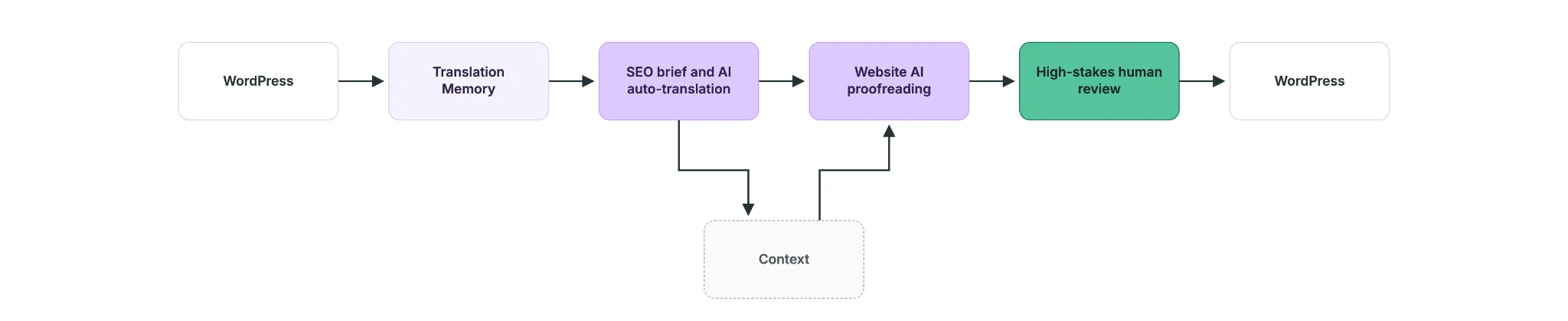
Marketing and SEO: Multi-step AI prompts where keyword research feeds into the translation before the first draft is even generated.
-
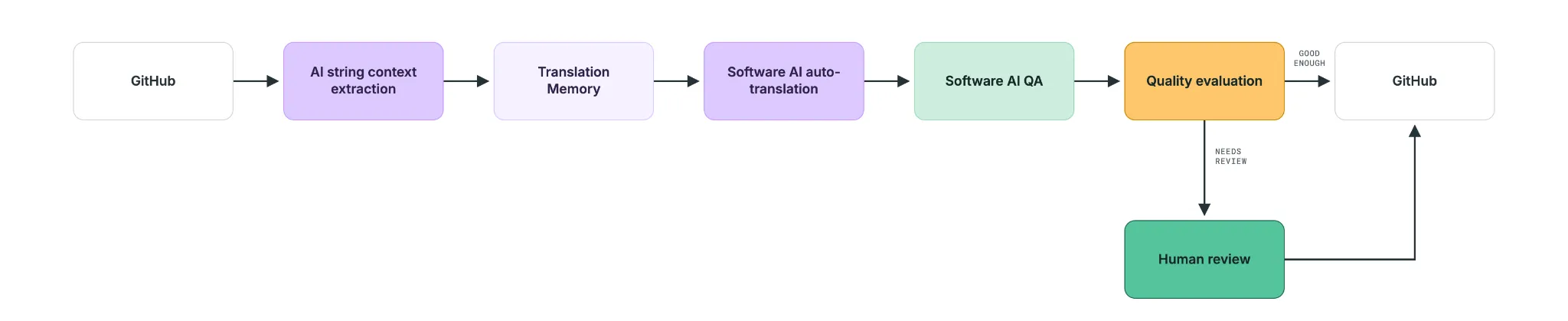
In-App and UI (Figma, GitHub): Stricter pipelines with targeted human evaluation for high-visibility UI strings.
2. Upgraded glossaries and style guides for AI
A key lesson from the migration was that assets written for human linguists don’t work for AI engines out of the box. A human specialist fills in context gaps naturally, while AI needs explicit instructions. Undertow restructured Sinch’s core assets accordingly:
- Layered glossaries: A core umbrella glossary for shared Sinch terminology, plus dedicated sub-glossaries for child brands like Sinch Mailjet and Sinch Mailgun.
- Explicit AI rules: Detailed use cases, market nuances, and forbidden terms written directly into system prompts.
"The linguistic infrastructure needs a serious upgrade. Glossaries, style guides, and prompts that work for humans are not the same as ones that work for AI. Getting that foundation right is the single most important step.
How it works now day-to-day: Automation + targeted LQA
To handle higher translation volumes while keeping budgets under control, Sinch moved away from reviewing 100% of translated content. Instead, they run an automated pipeline backed by a monthly quality loop:
- AI auto-translation: Content flows automatically from platforms like Zendesk, Gainsight, WordPress, and GitHub into Crowdin, where specific LLMs generate localized drafts tailored to that asset type.
- Targeted monthly LQA: Undertow’s language specialists conduct monthly Language Quality Assurance (LQA) on Sinch’s highest-traffic and business-critical content.
- Continuous feedback loop: During LQA, linguists categorize every error. Those findings are fed directly back into the glossaries, style guides, and prompt instructions so the AI stops repeating the same mistakes.
"Sinch processed ~5M words in the first 3 months of 2026 alone after they started using Crowdin vs 4M words total in 2025. The AI + targeted LQA model lets them deliver roughly 20x compared to their previous workflows within a really tight budget.
Data insights: How the AI engine performs at scale
To support their high-volume localization needs, Sinch connected their own LLM infrastructure via Crowdin’s Bring Your Own Key (BYOK) feature, standardizing their pipelines on Google’s Gemini 3.1 Pro.
Sinch and Undertow built focused, task-specific prompts for every stage of the workflow – ranging from initial pre-translation and alignment to term extraction and AI QA checks.
Translation breakdown by method
| Translation method | Share of total volume | Role in the ecosystem |
|---|---|---|
| AI Translation | 65% | Primary engine for high-volume, automated workflows |
| Human Translation | 27% | Direct human translation for sensitive or complex copy |
| Translation Memory (TM) | 8% | Instant matching for previously translated brand terms and UI elements |
Human proofreading and targeted quality control
While AI generates 65% of all initial translations, human expertise is applied through targeted review:
- 44% of AI-translated content undergoes human proofreading and LQA. This effort is focused strictly on high-stakes, customer-facing assets and core product interfaces.
- 56% of AI-translated content flows directly to publication without direct human review. This covers high-volume, lower-stakes content like support articles and internal documentation.
What’s next
With the core setup working smoothly, Sinch and Undertow are focusing on three main areas:
- Hyper-local quality: Making AI outputs sound natural and natively written for every target market.
- Market expansion: Rolling out new languages for regional expansion.
- Internal adoption: Bringing all internal teams across Sinch into the single Crowdin workflow.
"We want to bring every team into our localization workflow. There are teams that don’t have a fully defined localization process yet, and we want all their needs to be channeled through localization and Crowdin. Every team that tries Crowdin for their workflows becomes immediately convinced about the solution.
Localize your product with Crowdin

Yuliia Makarenko
Yuliia Makarenko is a marketing specialist with over a decade of experience, and she’s all about creating content that readers will love. She’s a pro at using her skills in SEO, research, and data analysis to write useful content. When she’s not diving into content creation, you can find her reading a good thriller, practicing some yoga, or simply enjoying playtime with her little one.