

A hiring decision can change someone’s life. When that decision rests on an assessment taken in Thai, Arabic or Japanese, every question has to measure exactly what it measures in English – even if that means rewriting it from scratch. For SHL’s localization team, this is the everyday standard. And it’s the standard they held AI to as well.
SHL has been helping organizations make talent decisions since 1977. Headquartered in the UK, the company combines psychometric science, assessment technology and people analytics to help employers answer questions like who to hire, who is ready to lead, and where their skill gaps are. Its assessments, reports and platform reach candidates and managers in dozens of languages.
We spoke with Avril Murray, Localisation Manager at SHL, about how her team prepared more than a decade of linguistic assets for AI translation.
| SUMMARY | |
|---|---|
| Company | SHL – talent assessment and people science, founded in 1977, headquartered in the UK |
| Content in Crowdin | Platform UI, via integration; translation memories for all content types – assessments, reports, platform UI and legal |
| Languages | 54 for the platform UI; assessments and reports vary by product and market |
| Main challenge | 10+ years of TM in one memory per language, with matches becoming less accurate |
| Key result | TMs for around 10 content types (close to 200 TMs) rebuilt in-house; UI term search down from 3–4 hours to seconds; AI translation that draws on curated TMs, glossaries and style guides |
Before: one translation memory per language, holding everything
SHL has a dedicated localization team that works closely with Science and Product. Because SHL is an international company, every product gets localized at some point in its lifecycle, so the team gets involved early – when products are still being designed. They flag anything that could cause trouble in other languages, and that feedback goes into the design.
Once a product is ready, content goes to language vendors, then to SHL’s local offices for review. Localization team runs QA checks before technical teams make the assessments live on the platform.
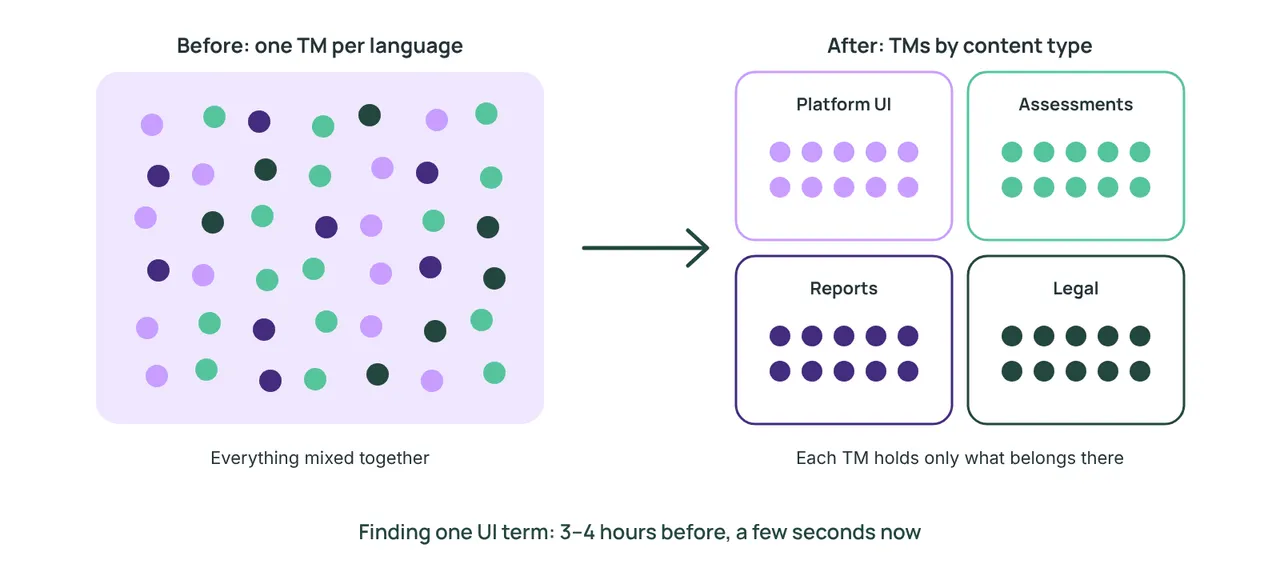
The translation memory side of this setup had grown in a simple way: one TM per language, containing everything ever translated into it.
This contained everything that had ever been translated in that language, which was great for leverage, but as the TMs grew the matches were becoming less accurate due to having all content types in the same one.
That structure also made everyday work slow. To check how a UI term was translated across languages, the team had to open more than 50 separate TMs – a search that could take 3–4 hours.
And then there was AI. SHL knew that before using its TM to improve AI translation, the memory would need a serious cleanup. With more than a decade of content to review, that looked overwhelming – so the initial plan was to hand the cleanup over to a vendor.
Solution: rebuilding translation memory by content type
Today, SHL localizes its platform UI directly in Crowdin. Assessments, reports and legal content are still translated by SHL’s language vendors outside Crowdin. But Crowdin is where SHL manages translation memory for all of these content types.
SHL chose Crowdin because it suited a team that wanted to stay hands-on.
I liked that Crowdin offered all the same features as many competitors, but seemed more flexible and customisable. A lot of other solutions were more heavily packaged and seemed aimed at organisations without a dedicated Localisation team. Crowdin was better suited to our desire to be hands-on in the Localisation process and to keep our existing relationships with our translation vendors. The customer service also far surpassed other providers we were looking at.
Searching and managing TMs in Crowdin also turned out to be easy – and that changed the whole plan for the cleanup.
Start with one multilingual TM for the UI
The first decision: UI content would live in a single multilingual TM.
Often we need to search for a UI term in all languages. Searching in one multilingual TM rather than opening over 50 every time we need to search a term has saved us hours of effort!
Then split every TM by content type
The UI experiment raised a bigger question: which other content types would benefit from their own TM? The answer led SHL to separate its translation memories completely by content type – a much-needed cleanup and a clearer strategy for TM management.
Instead of reviewing years of old translations one by one, the team created new TMs for each content type and imported only what belonged there.
Once we got Crowdin and saw how easy it would be to simply create a new TM for each of our content types rather than needing to go through our old TMs and review translations, we realised this was something we’d be able to manage ourselves.
The vendor cleanup project was no longer needed. Most of the effort went into thinking: working out how to split the content types and which translations to include was a quarter-long initiative. Creating each TM in Crowdin then took less than an hour.
Keep a separate TM per language where culture demands it
Not every content type fits a multilingual TM. SHL’s localization team reviews every piece of content before translation. It either reworks items that wouldn’t suit another culture, or gives translators clear guidance on how they can adapt them.
That means the same item can end up with different source versions for different cultures. For cognitive assessments, where rework is most common, SHL keeps a separate TM in each language rather than one multilingual memory.
Take TM updates in-house
SHL also changed who decides what goes into the TM. Vendors no longer update it at the end of a project. Instead, the team requests the TMX file and decides itself which TM the content belongs in.
Give AI as much context as possible
With clean, domain-specific TMs in place, SHL could put them to work for AI translation. In Crowdin, the team selects the relevant TMs and glossaries for each project.
Always as much as possible. We aim to use any relevant translation memories, along with a glossary, style guide, screenshots where possible, and string context where applicable. We also add instructions explaining the context and use case.
SHL currently uses GPT-4.1 and is researching other models.
After: a clear TM strategy and AI where it fits
SHL now owns its translation memory. The old one-TM-per-language setup gave way to TMs for around 10 content types: four multilingual TMs for the platform, plus TMs for different assessment types, each with separate language versions – close to 200 TMs in total. The team decides what goes into each one. And finding a UI term across all languages now takes a few seconds instead of 3–4 hours.
That foundation lets SHL bring in AI one content type at a time, based on risk.
| Content type | Approach | Why |
|---|---|---|
| Reports | Moving to AI-assisted translation with human review | Repetitive, predictable content with lower risk; human review keeps quality high while saving cost and time |
| Platform UI | AI-assisted is the next goal, to speed up releases | More work on string context comes first |
| Assessments | Human-led | Protects psychometric properties and the scientific rigor SHL is known for |
Because of the nature of our business, we would never use an AI-only approach.
What it means for the business
AI hasn’t changed how many languages SHL supports yet. What it will change is reach: SHL expects to release some products in new languages faster, and to offer more products in lower-usage languages, opening opportunities in smaller regions.
For leadership, cost and time savings drive AI adoption – never at the expense of quality. The conversation inside SHL is less about whether to use AI and more about how to do it well.
There’s a tendency to think it’s as simple as running everything through ChatGPT, but building a robust and defendable process takes time and investment.
This fits SHL’s company-wide AI-first strategy: doing what SHL already does, but better. In localization, that means making more products available in more languages, moving repetitive translation work from humans to AI, and adding AI-driven QA checks. Human translators can then focus where they bring the most value.
Sitting on years of legacy TM? SHL’s advice
Focus on the content you actually need to move your localization strategy forward. It’s tempting to keep old, outdated translations just in case, but when your TM feeds AI translation, that can backfire.
Garbage in, garbage out. Unlike the days of relying on TM matches, when it comes to using TMs for AI, less is often more.
What worked for SHL:
- Start fresh instead of reviewing everything. Creating a new TM took SHL less than an hour per content type – far easier than sifting through years of old translations.
- Make TMs domain-specific. One TM per content type keeps matches relevant and lets you pick exactly what the AI should use.
- Import only what you trust. Bring in translations that belong to that domain and whose quality you’re completely confident in.
- Own the TM yourself. Collect TMX files from vendors and decide where each piece of content goes.
What’s next for SHL
SHL is focusing on two areas:
- Model research across language groups. The team is studying how different AI models affect quality for high-resource, low-resource and character-based languages.
- Deeper integration with code repositories. Connecting Crowdin more closely to SHL’s repositories will speed up UI localization and bring AI-assisted UI translation within reach.
Doing more with what you already have
SHL’s story shows that getting ready for AI often starts with the assets you already own. A decade of translation memory became an advantage once it was organized around how the content is actually used. With the right structure in place, SHL can let AI take on repetitive work, keep people in charge of what needs their expertise, and bring more products to more languages.
Localize your product with Crowdin

Yuliia Makarenko
Yuliia Makarenko is a marketing specialist with over a decade of experience, and she’s all about creating content that readers will love. She’s a pro at using her skills in SEO, research, and data analysis to write useful content. When she’s not diving into content creation, you can find her reading a good thriller, practicing some yoga, or simply enjoying playtime with her little one.